Showing posts with label roots. Show all posts

Friday, May 4, 2012

The Five Observances of Yoga

Last week, we talked about the five "don'ts" of yoga, known as the yamas, from Pantajali's Eight-Limb Path to reach enlightenment. Those are the things you want to restrain from in order to reach the higher Truth. This week we'll talk about the things you want to observe, known as the niyamas.

1) Sauca is the act of cleanliness. But Patanjali wasn't referring only to bodily hygiene. He's talking about internal cleanliness as well, including moderating one's diet and also avoiding impurities of the ego. By practicing yoga poses, we often wring out the toxins in twisted postures and expel negative energy through the breath.

I can't help but see the word Sauza (as in the tequila) whenever I see the word sauca. It's ironic because that would be the opposite of cleanliness. Waking up in the morning with a hangover just feels dirty. And, yet, ironic again because alcohol can be used to clean things. But, that's a side note.

Lately, I've been practicing sauca by making a lot of vegetable juice from fresh veggies. A few times a week, I'll have a glass of juice from carrots, celery, beets, ginger, lemon, swiss chard, and spinach for breakfast. Nothing feels more cleansing. What's interesting is that, no matter how many food products we've created in modern times, we still refer to traditional fruits and veggies as the "cleanest" foods out there. Just read Dr. Alejandro Junger's book, Clean. Perhaps we should stop trying to modify the natural world?

Photo by SillyPucci

2) Santosa is the act of contentment. It's about being able to find the positive in challenging times and accepting external situations for what they are. Our teacher paraphrased a quote by saying "If you can control it, don't worry about it. And if can't control it, don't worry about it." I love this quote because it exemplifies how much unnecessary stress our culture goes through. If we stopped trying to control everything, we'd be much more harmonious and pleasant.

Finding joy in a trying time is one of the hardest things to do, but practicing it makes us stronger and more productive people. There have been many times in which my husband or I have been down about a job or financial situation and we often try to remind each other of the positive within the challenge. It quickly spins the situation into a lighter one.

3) Tapasya is engaging in practice and ritual. It's like having a fire inside that you have to tend to each and every day to keep it burning. That takes discipline and focus and faith in something greater than what we experience each day to believe the fire needs tending to.

I've been trying to cultivate a morning yoga practice when I first wake up and I'm still challenged by my sleepy limbs. My hope is that I'll grow into this tradition and learn to love it, especially when I travel for work, which I do a lot. It would be a way to come back home while on the road.

I don't believe that tapasya has to be yoga-related, however. For me, the ritual of walking the dogs every morning down the sandy arroyo next to my house feels like tapasya. It's quiet and gives me a chance to reflect and get lost in my thoughts (good ones, not citta-vritti or mind chatter), get the blood flowing, give the dogs some exercise, and feel the brisk morning air on my face.  And simply get inspired by the new day.

Oil painting of arroyo next to our house by my husband, Ian Troxell

4) Svadhyaya is the act of studying oneself. By doing this, we can magnify our intentions, tendencies, and habits. It's important to look at our actions to make sure they are coming from a positive place. Most importantly, this applies to our every day actions, like interacting with other people.

Misguided or sketchy intentions never make an action feel right and we often experience that heft on our shoulders for much longer than we hope to. By acting from a place of light, we can feel more free and content.

5) Lastly, Isvara-Pranidhana is the act of full surrender to the greater power. When one does this, everything comes from a positive place without the need for validation of this good behavior.

Nothing explains this more beautifully than an analogy my teacher made to a flower.
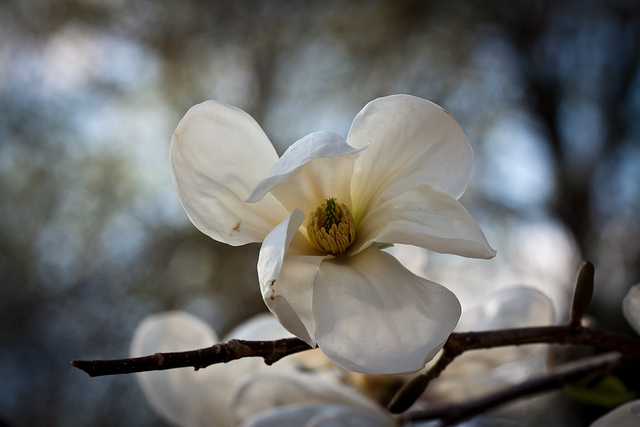
Photo by Tom Bech

A flower symbolizes true freedom because it is selfless: it blossoms and exists. We admire it for its aesthetic and its fragrance but the flower doesn't care who smells it or who doesn't. It is beautiful without the need for acknowledgment. It just simply is.

Saturday, April 28, 2012

The Five "Don'ts" of the Yogic Discipline: Post 2

In my last post, I explained the origin of eight-limbed yoga and described the very first idea in the first limb. The first limb, Yama, makes up the things you should restrain from when trying to attain enlightenment.

Besides non-violence (Ahimsa), there are four more things Patanjali says we should restrain from.

Satya is the practice of truth, so restraining from lying. This doesn't only mean not lying to others (which is a basic moral principle we learn as small children), it encompasses being honest with ourselves as well as accepting the concept of Truth, the fact that there is a greater universal truth to align ourselves with.

I feel a particular connection to Satya simply because my name (Alicia) means honesty. And, because my parents handed down a version of my mother's middle name, Alice, I feel a level of responsibility in upholding and representing this meaning.

Mom (Martha Alice) and Daughter (Alicia Marie)

While many of us associate lying and honesty with the things we say, it also applies to the things we do. It is important to be honest with ourselves about jobs, relationships, the value of things, etc, in order to find happiness.

The concept of a greater Truth is one I am still churning over in my mind. I wasn't raised with any type of faith or religion and, until now, I'd subscribed to the theory of science, however, I've always believed in souls and a level of spirituality. So, for now, I'm still formulating my own philosophy on this one.

Asteya is the practice of not-stealing. It goes hand-in-hand with the next ideal within the Yamas, which is Aparigraha, the principle of not hoarding. Again, most of us will associate this with material things. And, yes, it is good to not steal or hoard those too. But Asteya and Aparigraha also refer to attention and energy. In order to become aligned with greater enlightenment, we have to refrain from always having the focus on ourselves. For instance, if a friend asks how your day is going or how something in your life is going, it's nice to fill them in and then return the energy and ask how that person is doing as well. Be generous with our attention, focus, and support.

Another part of Aparigraha that also relates to Ahimsa, being kind to ourselves, is to not hoard food. 


Lastly, Brahmacarya is sexual responsibility and moderation. This means respecting your partner and understanding that there is a heart on the other end of the physical activity. It's important to be kind to it and respect it. And, not be frivolous with our own hearts when it comes to intimacy, either.

Between Ahimsa, Satya, Asteya, Aparigraha, and Barhmacarya, which Yama do you most relate to and why?

The Five "Don'ts" of the Yogic Discipline: Post 1

This week in yoga school at Body, we've been discussing the very roots of the tradition. According to Patanjali's Yoga Sutras, one of the first texts on yoga written around 2200 years ago, one could achieve enlightenment by following an eight-limbed path. The path covered everything from ethics to physical practice to breathing and meditation.

Many if not all of the practices from The Yoga Sutras are still relevant today. And, in a lot of ways, his teachings are even more significant because we have so many more distractions in life: television, jobs, social life, social media, etc, that take us away from really rooting into ourselves and taking the time to make good, thorough decisions or actions. Reminding ourselves of these things is more important than ever.

The first leg on Patanjali's eight-limbed path to enlightenment is called Yama, which is basically a code of ethics on five things one should restrain from. By restraining, one will have an easier time creating harmony in his or her life.

The first principle is one I feel the most profoundness in, so I'm dedicating this post to it.

Ahimsa: The first restraint is violence. Now, the obvious example here is physical violence (murdering, punching, kicking, etc), but Patanjali's message was more intrinsic than this. Ahimsa means not only not harming others physically and emotionally, but also not harming yourself, the environment and other living beings. Practicing this principle requires a level of compassion and respect, and I admire both of those qualities.

One of the biggest lessons or reminders I've taken from Ahimsa is to not engage in gossip when it sparks up in conversation. We all know it happens more often than we'd like and, in truth, it's usually neither productive nor beneficial to anyone. My teacher described a simile I loved in which gossip is the worst weed in the garden—it's not only the ugliest thing, it grows and spreads swiftly and often overtakes what is beautiful.

Photo by EssJayNZ

Because I work in the outdoor world—and often play in the mountains, ocean, snow, rivers—having a level of respect for the environment feels natural for me. By practicing Ahimsa, I'm more often reminded to bring reusable grocery bags into the store, to bike and walk more, and avoid packaged items and plastic containers when I can.

One principle of Ahimsa that I don't currently follow is vegetarianism. I was a vegetarian for five years as a teenager and often tend towards meat-free options today, but my husband does eat meat and since we often cook dinner together, it's difficult (and costly) to make separate meals. That said, since yoga school has started, I've opted towards vegetarian options whenever possible. Because of that, I feel lighter (physically and spiritually) and healthier. It's important to note I'm substituting meat for veggies, fruits, and tofu and not pasta and cheese (as I once did in my teenage years). <---That's for you, mom.

Which aspects of Ahimsa do you practice and which do you hope to follow more deeply?