1) Sauca is the act of cleanliness. But Patanjali wasn't referring only to bodily hygiene. He's talking about internal cleanliness as well, including moderating one's diet and also avoiding impurities of the ego. By practicing yoga poses, we often wring out the toxins in twisted postures and expel negative energy through the breath.
I can't help but see the word Sauza (as in the tequila) whenever I see the word sauca. It's ironic because that would be the opposite of cleanliness. Waking up in the morning with a hangover just feels dirty. And, yet, ironic again because alcohol can be used to clean things. But, that's a side note.
Lately, I've been practicing sauca by making a lot of vegetable juice from fresh veggies. A few times a week, I'll have a glass of juice from carrots, celery, beets, ginger, lemon, swiss chard, and spinach for breakfast. Nothing feels more cleansing. What's interesting is that, no matter how many food products we've created in modern times, we still refer to traditional fruits and veggies as the "cleanest" foods out there. Just read Dr. Alejandro Junger's book, Clean. Perhaps we should stop trying to modify the natural world?

Photo by SillyPucci
2) Santosa is the act of contentment. It's about being able to find the positive in challenging times and accepting external situations for what they are. Our teacher paraphrased a quote by saying "If you can control it, don't worry about it. And if can't control it, don't worry about it." I love this quote because it exemplifies how much unnecessary stress our culture goes through. If we stopped trying to control everything, we'd be much more harmonious and pleasant.
Finding joy in a trying time is one of the hardest things to do, but practicing it makes us stronger and more productive people. There have been many times in which my husband or I have been down about a job or financial situation and we often try to remind each other of the positive within the challenge. It quickly spins the situation into a lighter one.
3) Tapasya is engaging in practice and ritual. It's like having a fire inside that you have to tend to each and every day to keep it burning. That takes discipline and focus and faith in something greater than what we experience each day to believe the fire needs tending to.
I've been trying to cultivate a morning yoga practice when I first wake up and I'm still challenged by my sleepy limbs. My hope is that I'll grow into this tradition and learn to love it, especially when I travel for work, which I do a lot. It would be a way to come back home while on the road.
I don't believe that tapasya has to be yoga-related, however. For me, the ritual of walking the dogs every morning down the sandy arroyo next to my house feels like tapasya. It's quiet and gives me a chance to reflect and get lost in my thoughts (good ones, not citta-vritti or mind chatter), get the blood flowing, give the dogs some exercise, and feel the brisk morning air on my face. And simply get inspired by the new day.

Oil painting of arroyo next to our house by my husband, Ian Troxell
4) Svadhyaya is the act of studying oneself. By doing this, we can magnify our intentions, tendencies, and habits. It's important to look at our actions to make sure they are coming from a positive place. Most importantly, this applies to our every day actions, like interacting with other people.
Misguided or sketchy intentions never make an action feel right and we often experience that heft on our shoulders for much longer than we hope to. By acting from a place of light, we can feel more free and content.
5) Lastly, Isvara-Pranidhana is the act of full surrender to the greater power. When one does this, everything comes from a positive place without the need for validation of this good behavior.
Nothing explains this more beautifully than an analogy my teacher made to a flower.
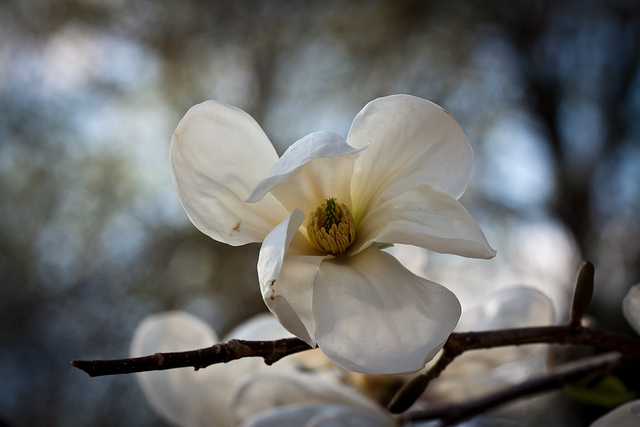
Photo by Tom Bech
A flower symbolizes true freedom because it is selfless: it blossoms and exists. We admire it for its aesthetic and its fragrance but the flower doesn't care who smells it or who doesn't. It is beautiful without the need for acknowledgment. It just simply is.


